
When you’re exploring therapy options, you might come across terms that seem similar but are actually quite different. Two such therapies are Eye Movement Desensitization and Reprocessing (EMDR) and hypnosis. Many people wonder if they are related, and it’s a fair question. Both can help you work through difficult experiences, but they do so in fundamentally different ways.
If you’re seeking clarity on EMDR vs. hypnosis, you’ve come to the right place. This post will explain what each therapy includes.
It will also show their main similarities and differences. Finally, it will help you find the best fit for your needs. Understanding these distinctions is the first step toward making an informed, empowered decision about your mental health journey.
What Is EMDR?
Eye Movement Desensitization and Reprocessing (EMDR) is a structured, evidence-based psychotherapy designed to help people heal from trauma and other distressing life experiences. It is recognized by major health organizations, including the American Psychiatric Association (APA) and the World Health Organization (WHO), as a highly effective treatment for PTSD.
Unlike traditional talk therapy, EMDR does not require you to describe a painful event in detail. Instead, it uses bilateral stimulation—such as guided eye movements, tapping, or sounds—to help your brain reprocess “stuck” memories. The goal is to reduce the emotional charge of these memories, allowing you to recall the event without feeling overwhelmed by the intense, negative feelings originally associated with it. This process helps shift negative beliefs about yourself into positive, more adaptive ones, promoting emotional balance and resilience.

What Is Clinical Hypnosis Therapy?
Hypnotherapy, or clinical hypnosis therapy, is a therapeutic technique that uses guided relaxation and intense concentration to achieve a heightened state of awareness, often called a trance. While in this state, a person is more open to suggestion. A trained therapist uses this focused attention to help individuals explore painful thoughts, feelings, and memories that might be hidden from their conscious minds.
The main goal of hypnotherapy is to use suggestion to create positive changes in thoughts, feelings, or behaviors. People often use it to address habits like smoking or overeating, manage pain, and reduce stress. While hypnosis can be a powerful therapeutic tool, its methods and level of clinical recognition can vary.
Key Similarities Between EMDR and Hypnosis
At a glance, it’s easy to see why EMDR and hypnotherapy are sometimes confused. They share a few core principles:
- Both involve guided focus: In both therapies, a trained clinician guides your attention. In EMDR, the focus is on a specific memory while engaging in bilateral stimulation. In hypnosis, the focus is on achieving a trance-like state to access the subconscious mind.
- Both help reframe painful experiences: The ultimate goal of both approaches is to change your relationship with past events or current struggles. They aim to reduce emotional distress and help you develop healthier perspectives and coping mechanisms.
Key Differences Between EMDR and Hypnosis
Despite the similarities, the differences between EMDR and hypnosis are significant. Understanding these therapies is important. This is especially true for parents who are worried about what a session might involve for their teen.
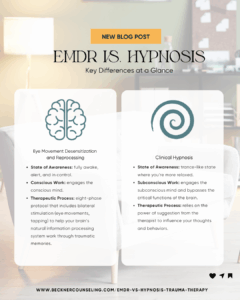
- State of Awareness: This is the most critical distinction. During an EMDR session, you are fully awake, alert, and in control. You are always aware of your surroundings and can stop the process at any time. Hypnosis helps you enter a trance-like state. In this state, your conscious mind relaxes. This makes you more open to suggestions.
- Conscious vs. Subconscious Work: EMDR mostly engages the conscious mind, while hypnosis guides you into working more with your subconscious. For a deeper exploration of how both therapies aim to create a “special learning state,” see this Psychology Today article.
- The Therapeutic Process: EMDR uses a specific, eight-phase protocol that includes bilateral stimulation (eye movements, tapping) to help your brain’s natural information processing system work through traumatic memories. The healing comes from within your own mind’s ability to reprocess. Hypnosis relies on the power of suggestion from the therapist to influence your thoughts and behaviors while you are in a suggestible state.
- Research and Recognition: EMDR is a highly researched and standardized treatment protocol, endorsed by major international health organizations for treating PTSD. The effectiveness of hypnosis can vary, and it does not have the same level of uniform endorsement from major psychiatric bodies, though it is recognized as a valid tool for certain conditions.
EMDR vs. Hypnosis: Which Is Right for You?
Choosing between EMDR and hypnosis depends entirely on your personal history, symptoms, and therapeutic goals.
EMDR may be a good fit if you are dealing with:
- Trauma or Post-Traumatic Stress Disorder (PTSD)
- Anxiety, phobias, or panic attacks
- Complicated grief
- Low self-worth or negative self-beliefs tied to past events
- Feeling “stuck” in traditional talk therapy
Hypnosis might be more suitable if you want to focus on:
- Changing specific habits (e.g., quitting smoking)
- Stress reduction and deep relaxation
- Pain management
- Addressing certain types of anxiety or phobias
It’s always best to discuss your options with a mental health professional who can help you determine the most appropriate path forward.

How Beckner Counseling Uses EMDR
We are proud to offer EMDR therapy at our Leesburg, VA office. We believe in providing compassionate, evidence-based care that empowers you to heal. Our approach to EMDR is rooted in creating a safe, supportive environment where you can process difficult experiences without judgment.
Our trained EMDR therapists, Dylan Beckner and Amy White, specialize in helping clients manage trauma, anxiety, and other stress-related challenges. We have seen firsthand how EMDR can help individuals achieve emotional balance and build lasting resilience. We often use it as a special method for people who feel that regular talk therapy hasn’t helped enough.
Frequently Asked Questions
1.) Is EMDR related to hypnosis?
No. While both therapies involve a guided focus, EMDR is not a form of hypnosis. In EMDR, you are fully awake and conscious throughout the session. The process uses your brain’s ability to reprocess memories. It does this with bilateral stimulation, not through suggestions in a trance state.
For more information on how EMDR specifically addresses trauma, check out our detailed post on EMDR therapy in Leesburg.
2.) Can EMDR and hypnosis be used together?
Yes, in some cases, EMDR and hypnosis can complement each other. While each therapy uses different techniques—EMDR focuses on engaging your mind through rhythmic eye movements or taps to help reprocess difficult memories, whereas hypnosis guides you into a deeply relaxed state to facilitate openness to positive suggestions—both can support healing in unique ways. For instance, hypnosis may help clients relax and prepare for EMDR sessions, or assist with managing anxiety before beginning trauma work. Beckner Counseling specializes in EMDR and tailors this evidence-based approach to align with your unique goals, always prioritizing your comfort and well-being at every step.
3.) Is EMDR or hypnosis better for trauma?
When it comes to healing from trauma, EMDR stands out as a highly effective, evidence-based approach. Major health organizations, like the World Health Organization and the American Psychiatric Association, recognize it for its proven results. It helps people recover from tough experiences. We focus on EMDR because it helps many clients process trauma gently and safely, with real support. Hypnosis may have benefits for some, but EMDR is consistently recommended as a first-line treatment for trauma due to its strong research foundation and lasting outcomes.
Start Your Healing Journey Today
Taking the first step toward therapy can feel daunting, but you don’t have to do it alone. Understanding your options is a powerful move toward regaining control of your life. If you are in Leesburg, Virginia, or anywhere in Loudoun County, we can help you with EMDR.
Our compassionate team is ready to answer your questions and support you on your journey to healing.